
Today, social media has become a strategic pillar for businesses and companies seeking to increase visibility, attract customers, and build audience loyalty. However, effectively managing multiple social platforms can be challenging: scheduling posts, analyzing results, managing interactions, and optimizing campaigns requires time and organization. This is where social media management tools come into play, designed to centralize and simplify all these tasks.
In this article, we will explore the key points for choosing the best platform, compare some of the most popular ones like Metricool, Hootsuite, Buffer, and Sendible, and see how these tools can transform your company’s digital strategy.

Why is it important to use social media management tools?
Time and resource optimization
Management tools allow you to schedule posts across different platforms in advance, avoiding the need to log in manually every day. This not only saves time but also enables content planning aligned with marketing objectives.
Analysis and metrics
Data analysis is essential for measuring campaign performance. These platforms provide metrics on reach, engagement, clicks, conversions, and audience growth, making it easier to make decisions based on real data.
Brand Consistency
Maintaining a consistent visual and communication identity is key for customers to recognize your business. These tools make it easier to keep consistency across all profiles.
Interaction Management
The volume of messages and comments can be overwhelming. A good tool allows you to centralize communication, improving customer service and strengthening the relationship with your audience.
Comparison of Popular Tools
Metricool
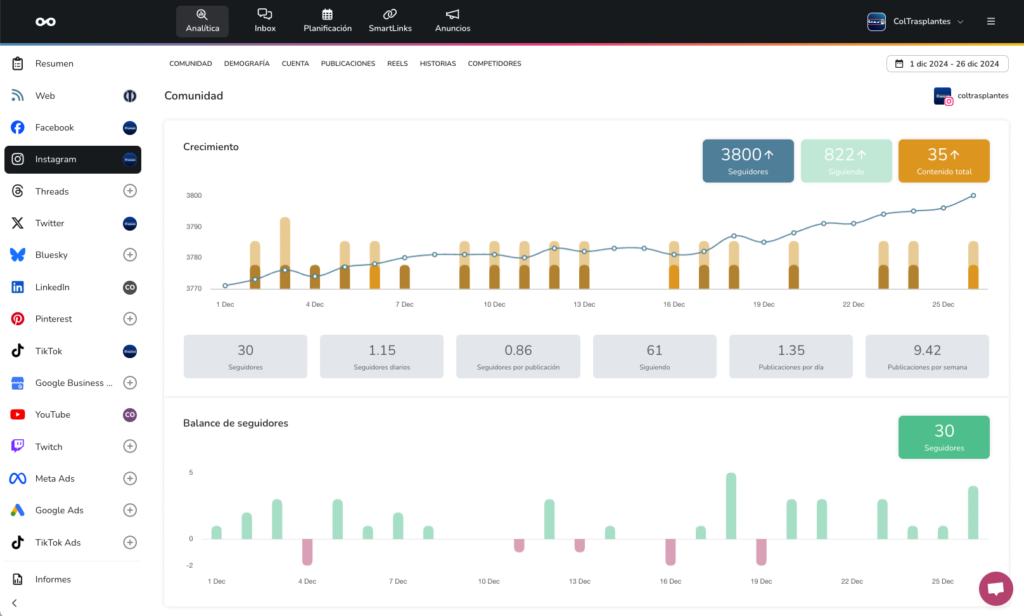
Metricool is a favorite among SMEs and content creators thanks to its ease of use. At Pixelpro, we use it and recommend it for managing your social media content. It also generates statistical reports and comparisons with your competitors.
- Advantages: Intuitive interface, Spanish version, affordable price, detailed analytics, option to manage Google and Facebook Ads campaigns.
- Disadvantages: Limitations in team collaboration features.
- Ideal for: Entrepreneurs and small businesses looking for simplicity and clear reports.
Hootsuite
With more than 18 million users, Hootsuite is one of the most recognized platforms worldwide.
- Advantages: Extensive scheduling features, advanced analytics, integration with over 35 social networks, collaboration, and social listening.
- Disadvantages: Its cost can be high for small businesses.
- Ideal for: Large companies or marketing agencies managing multiple clients.
Buffer
Buffer is known for its focus on simplicity and productivity.
- Advantages: Easy to use, affordable plans, good mobile experience.
- Disadvantages: Less advanced reporting compared to Hootsuite.
- Ideal for: Small businesses and freelancers seeking efficiency at low cost.
Sendible
Sendible is geared towards agencies and marketing teams managing multiple clients simultaneously.
- Advantages: Excellent management of multiple accounts, customizable reports, team collaboration features, as well as an easy interface.
- Disadvantages: Can be complex for beginners.
- Ideal for: Marketing agencies and companies with a high volume of clients.
Hubspot
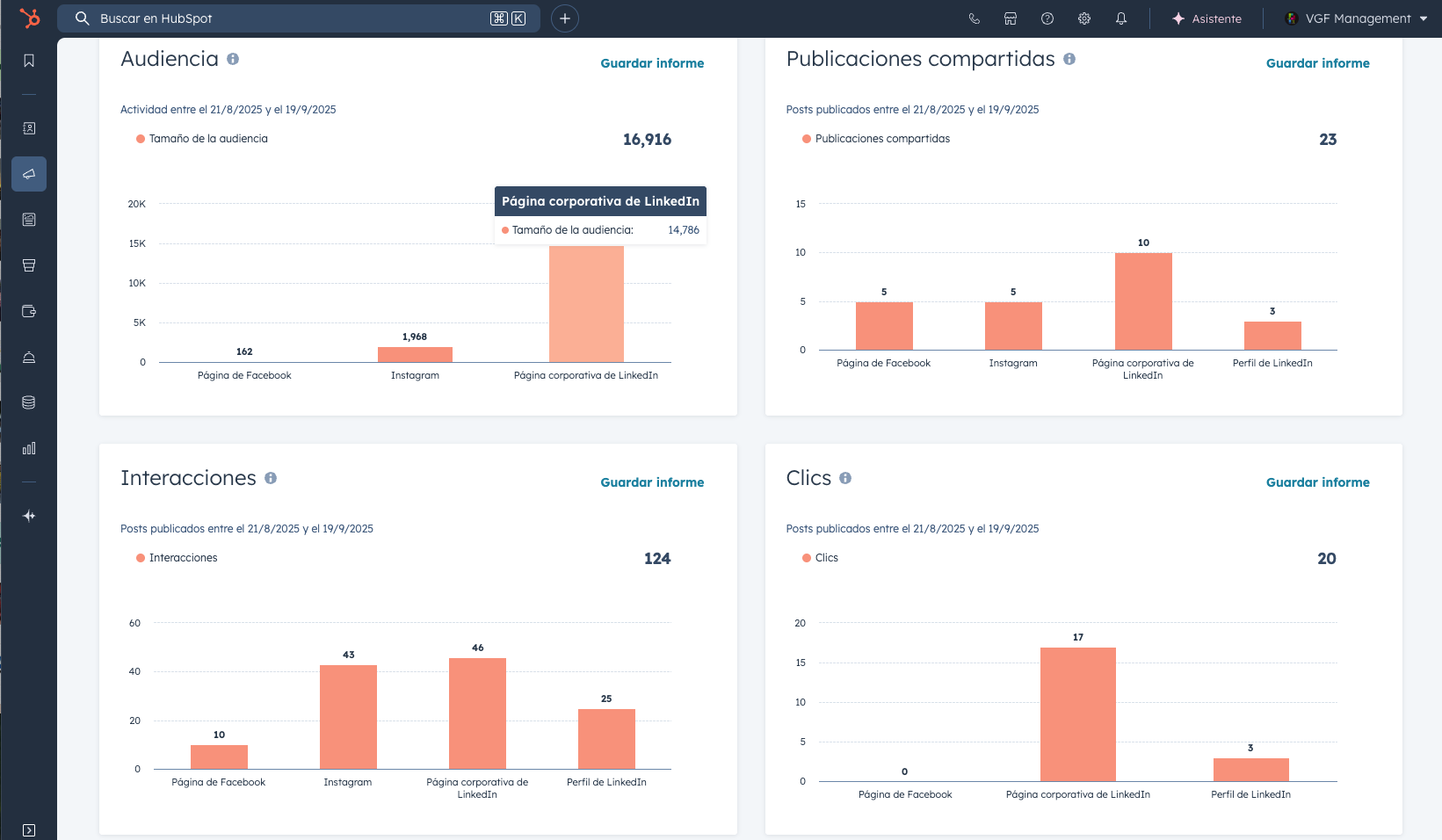
- Advantages: Integrates social media management with CRM; complete campaign tracking; AI-supported post generation; monitoring mentions and keywords; reports linking social interactions with sales conversions.
- Disadvantages: High price at mid and upper levels; some features like AI for posting are in beta version or limited; may be excessive for those managing only simple social networks.
- Ideal for: Businesses that want not only to publish content but to turn social networks into sales channels, connect social media with CRM, and easily measure ROI.
Other options to consider
- META Planner: The best-known solution within Facebook’s manager. From there you can schedule your posts, reels, and much more.
- Canva: Design attractive visual content without needing graphic design experience, and from your profile (if you have the PRO version) you can directly schedule your posts on each social network.
- Sprout Social: Powerful for data analysis and social listening.
- Later: Widely used on Instagram for its visual calendar options.
- Zoho Social: Good alternative for companies already using the Zoho ecosystem.
Keys to choosing the best tool
Define your goals
Before choosing a platform, ask yourself: do you want to increase followers, improve customer service, or generate more sales? Each tool has different strengths.
Evaluate your budget
The cost can range from free plans to enterprise subscriptions exceeding 100 USD per month. Define how much you are willing to invest.
Consider ease of use
A tool with too many features can be overwhelming if your team lacks experience. Choose a user-friendly interface.
Support and updates
Opt for platforms that offer reliable technical support and constant updates to address changes in social media algorithms.
The Future of Mobile Marketing: Connecting with Consumers in the Digital Age
Trends 2025 in Social Media Management
1. Integration of artificial intelligence
In 2025, the use of AI-based tools to generate social content grew significantly. More than 69% of social media specialists consider AI a revolutionary technology for creativity and productivity. Tools like HubSpot already offer automatic writing assistants for captions and content suggestions based on interaction trends.
2. Social Listening as a Strategic Priority
The Hootsuite Social Media Trends 2025 study reports that 62% of social media professionals use social listening tools, making it the second priority in many organizations, only after audience engagement. This enables the detection of crises, emerging trends, and content opportunities in real time.
3. Mastery of Short-Form Video Content
Platforms like TikTok, Instagram Reels, and YouTube Shorts continue to gain momentum. According to Sprinklr, short videos generate the most engagement, and social advertising spending is expected to grow annually by around 9-10% through 2030.
4. Multichannel Users and Diversified Behavior
The global average shows that a user accesses about 6-7 social networks per month. For businesses, this means that posting on a single platform is not enough: content must be adapted to the format that works best on each platform, as well as optimizing posting strategies according to the specific schedules and habits of each audience.
5. Measurement and Focus on ROI
By 2025, social media managers are increasingly under pressure to demonstrate concrete results: visits, leads, conversions. Platforms like HubSpot allow linking social interactions with CRM data to see which posts or campaigns generate real customers. HubSpot+1
6. Social commerce
More and more social networks are integrating native direct purchase features (shoppable posts, catalogs, in-app marketplaces). According to El País, social commerce already accounted for approximately 19.4% of total online sales in 2024, and it is projected to continue growing.
Frequently Asked Questions (FAQs)
1. What is the best free tool for managing social media?
Buffer and Metricool offer limited free plans, ideal for beginners. At Pixelpro we use and recommend Metricool; we manage our social media and some of our clients’ from there.
2. Can I manage ad campaigns from these platforms?
Yes, tools like Metricool and Hootsuite allow integration of digital advertising management. You can also do it from META’s ADS Manager.
3. What if I manage multiple brands?
Platforms like Metricool, Sendible, and Hootsuite are better suited for managing multiple accounts and clients. They are ideal for marketing agencies or freelancers handling accounts for different companies or businesses.
4. Do management tools replace a community manager?
Not at all. They make work easier, generate reports, organize posts, but human judgment is needed to create effective strategies.
5. What aspects should I prioritize when choosing a tool?
Your budget, marketing goals, number of social networks, and team experience.
In short
Social media management tools have become essential allies for any company or business that wants to stand out in the digital environment. Choosing the right one will depend on your specific needs, budget, and marketing goals.
In 2025, the integration of artificial intelligence, automation, and predictive analytics makes social media management more efficient than ever. Whether you use Metricool, Hootsuite, Buffer, Sendible or another tool, the key is to centralize, measure, and optimize so your business stays competitive and continuously grows.
Don’t wait any longer to implement these strategies and take your business to the next level. Write to us, at Pixelpro we help you manage your social media.
Remember, social media success requires time, dedication, and above all, authenticity!

Web Designer, Digital Marketing Consultant, and SEO Specialist with more than 20 years of experience delivering projects for the private, public, and education sectors.
I have extensive experience in the design, implementation, and optimization of websites, intranets, extranets, information systems, eCommerce platforms, eLearning solutions, and digital marketing campaigns. I excel at understanding client needs and providing strategic guidance on how to leverage digital marketing to achieve business goals and drive measurable results.
Since 2013, I have been providing my services through PIXELPRO, where I have carefully assembled a team of experienced professionals who uphold the standards of quality, reliability, and commitment that have defined my work throughout my career.


